The game

IP Empire™
played for what you already own.

Forty-five minutes at a table, five seats, and a company on each mat that owns six things it cannot afford to protect. Everyone can see what you leave open. At the end a buyer arrives and values what is left. It is the fastest way we know to put an IP decision in someone’s hands rather than on a slide.
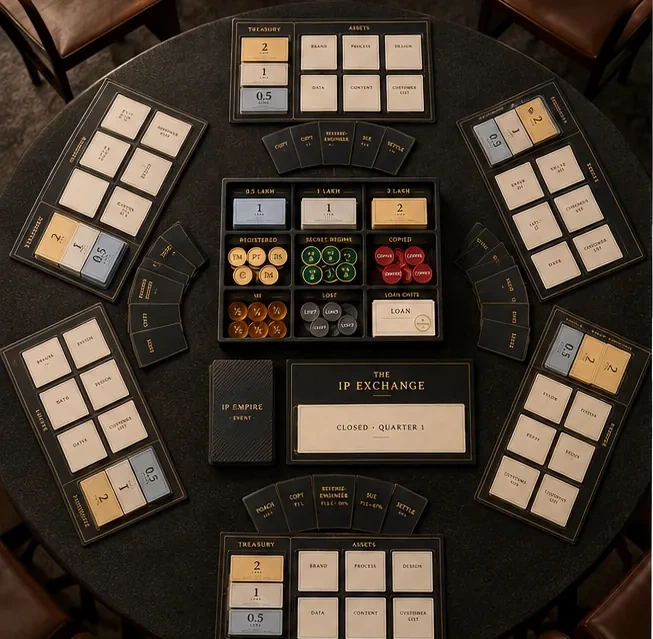
The IP Empire table: five company mats, the bank tray, the event deck and the IP Exchange board
One game, five frames · setup, Quarter 2 in play, the table at eye level, and the two scoresheets it ends on
45 min
One sitting, start to debrief
4–6
Players, five is the game
6
Assets on every mat
₹3 L
Capital, against ₹4.5 L of need
3
Quarters before the buyer
28
Pages of rulebook, below
You own six things. You can afford to protect about half. Everyone will see what you leave open. In forty minutes a buyer values you.

That is the whole briefing the Host gives before the first quarter. Nothing else is explained in advance — the rules arrive when a player needs them, which is the only moment anyone remembers a rule.

The pieces

Every piece stands for something real.

If a player picks something up and asks what it is, the answer is never “a game piece”. It is a registered right, or a contract, or a bank that will lend against one. That is the point of building it in brass and board rather than slides.

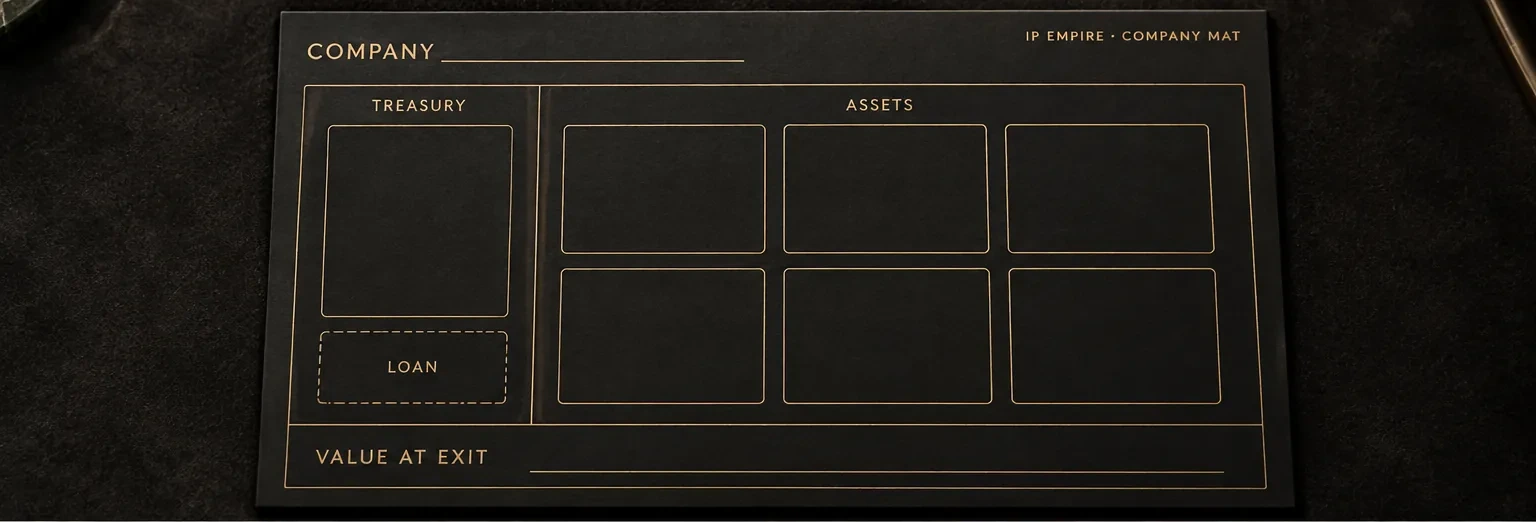
The IP Empire company mat: Treasury, six asset slots and a Value at Exit line
The company mat — your company as a buyer sees it

Three zones and nothing else: Treasury (cash and debts), Assets (six slots), Value at exit. Every seat gets the same mat. Nothing on it is company-specific, so nobody can blame their industry.

The six IP Empire asset cards: brand, process, product form, data list, content and lease
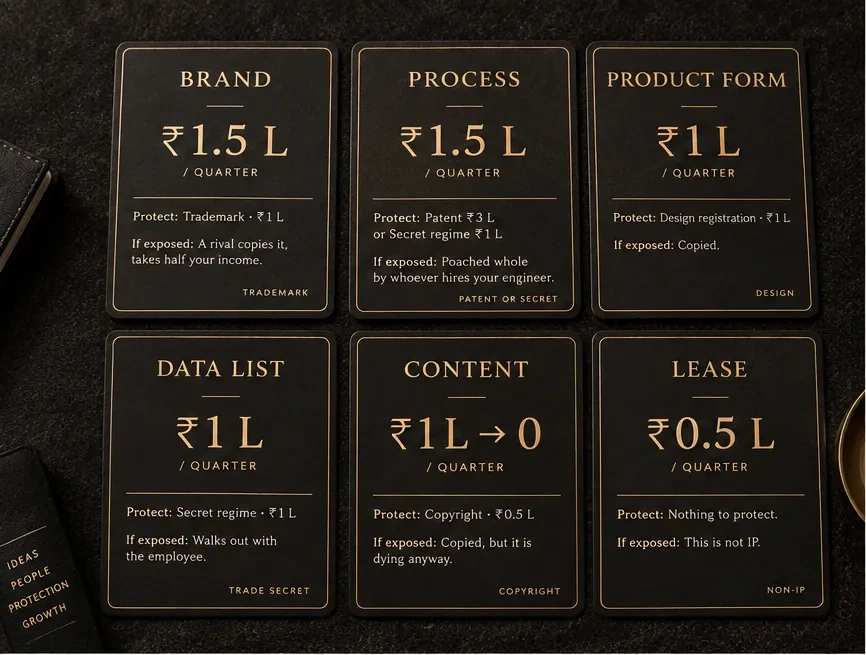
Six asset cards — things already inside the company

Brand, process, product form, data list, content — and a lease. The lease is there on purpose: one valuable thing on the mat that no token can protect, so the boundary of IP is learned by hitting it rather than being told it.

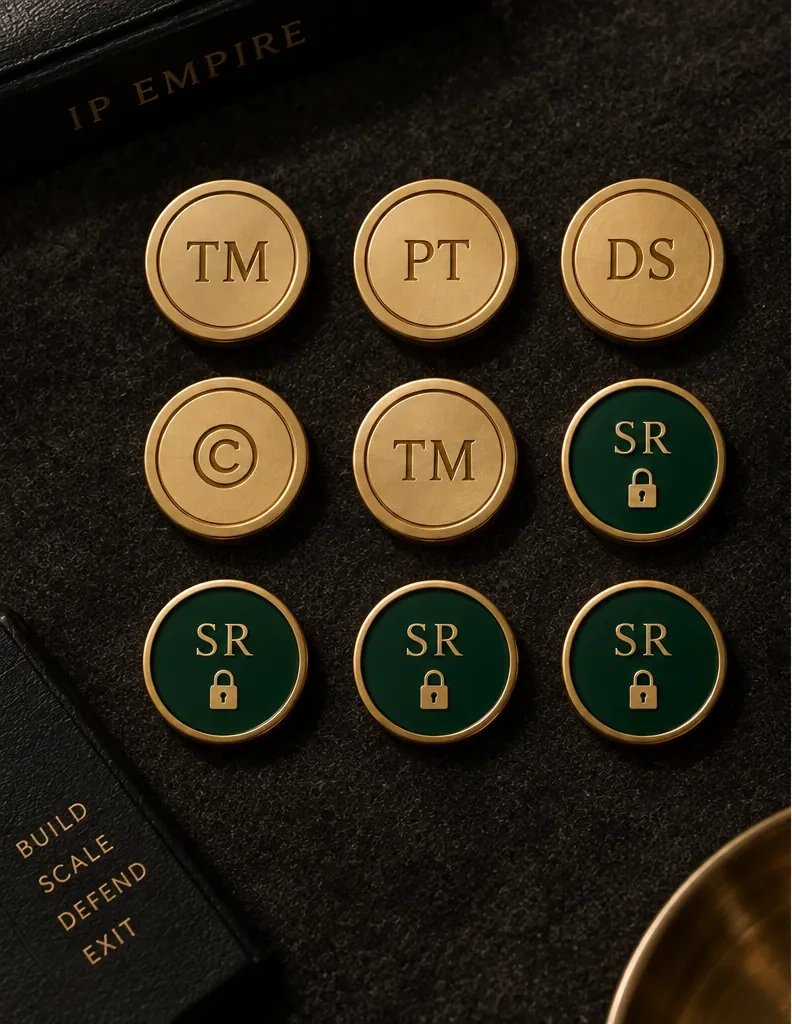
Gold registration tokens and the green secret-regime token
Gold and green tokens — a registered right, or a secret kept

Gold is a trademark, patent, design or copyright: public, certificated, enforceable. Green is a secret regime — NDAs, clauses, access control. It costs ₹1 L where a patent costs ₹3 L, and that price gap is the entire patent-versus-secret decision, made with real money.

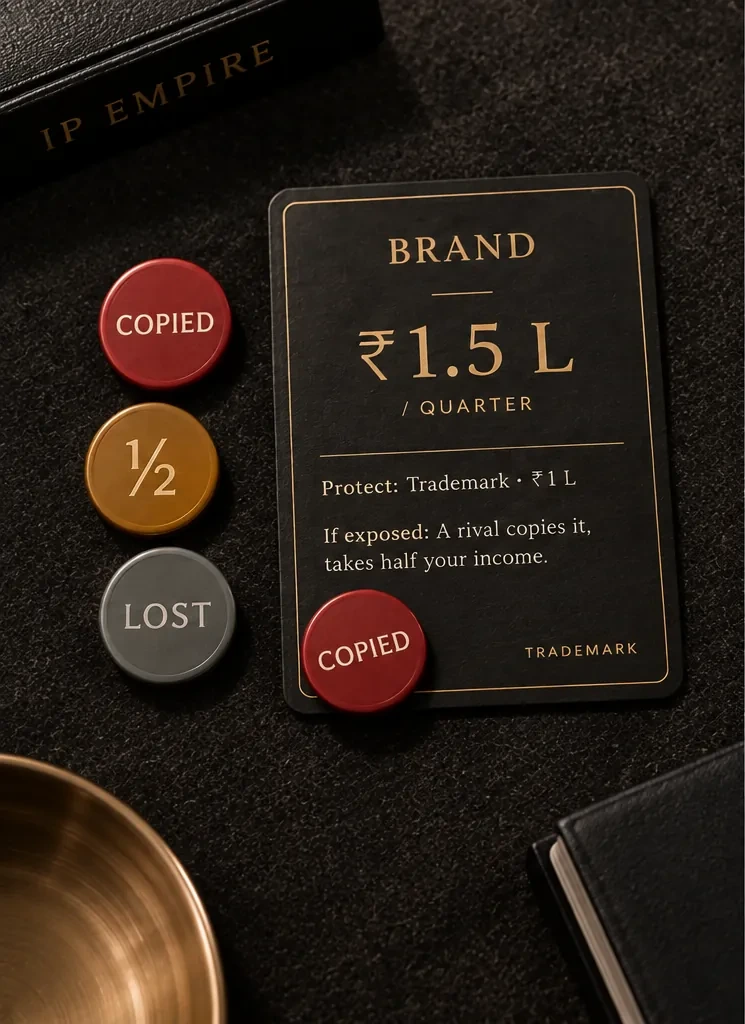
COPIED, half-income and LOST status chips
Status chips — what happens to an asset you left open

Red COPIED: someone is selling your thing and takes half your income. Amber ½: market damage you could not stop. Grey LOST: the asset walked out, or the bank took it, and counts nothing at exit.

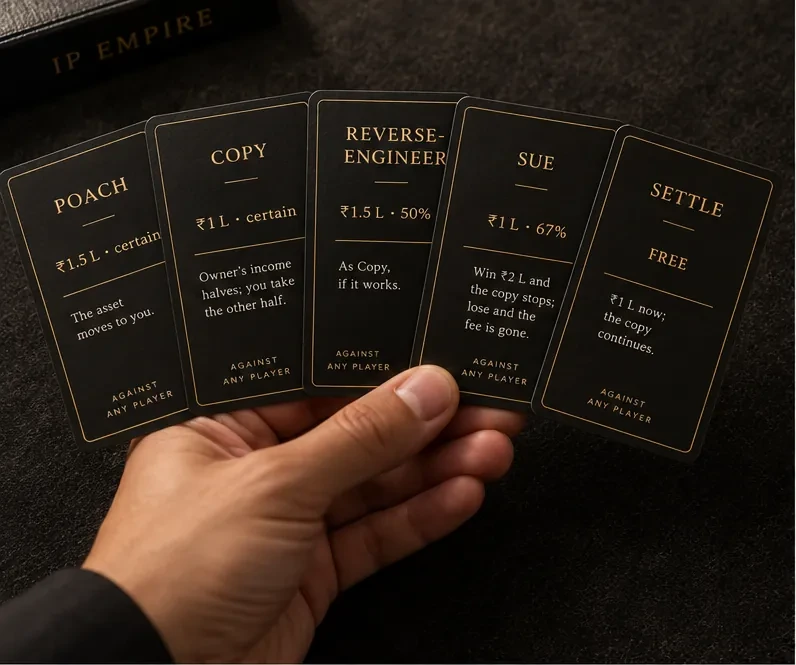
The five IP Empire action cards
Five action cards — the moves competitors actually make

Hire away a key person, sell a knock-off, tear a product down, litigate, settle. One per player per quarter, played in seat order, in the open. Nobody gets to be surprised by competition.

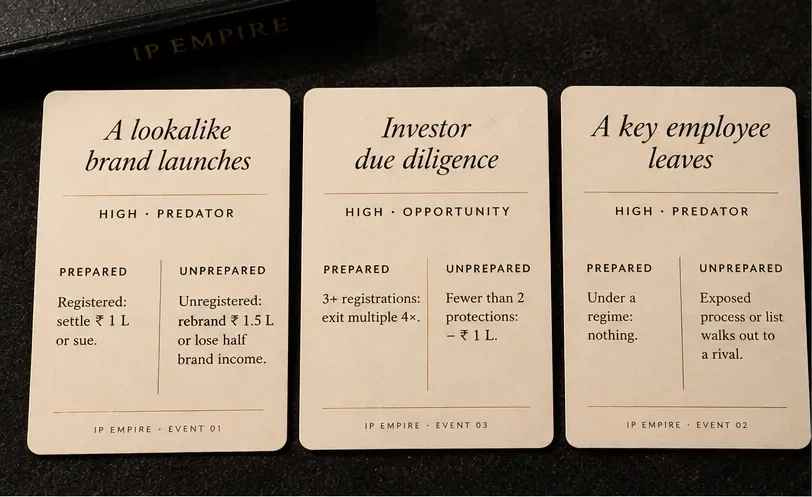
The twelve cream event cards
Twelve event cards — things that happen to a whole market

The same card hits every seat. Preparation decides who gains from it and who pays for it — which is the honest version of “the market moved”.

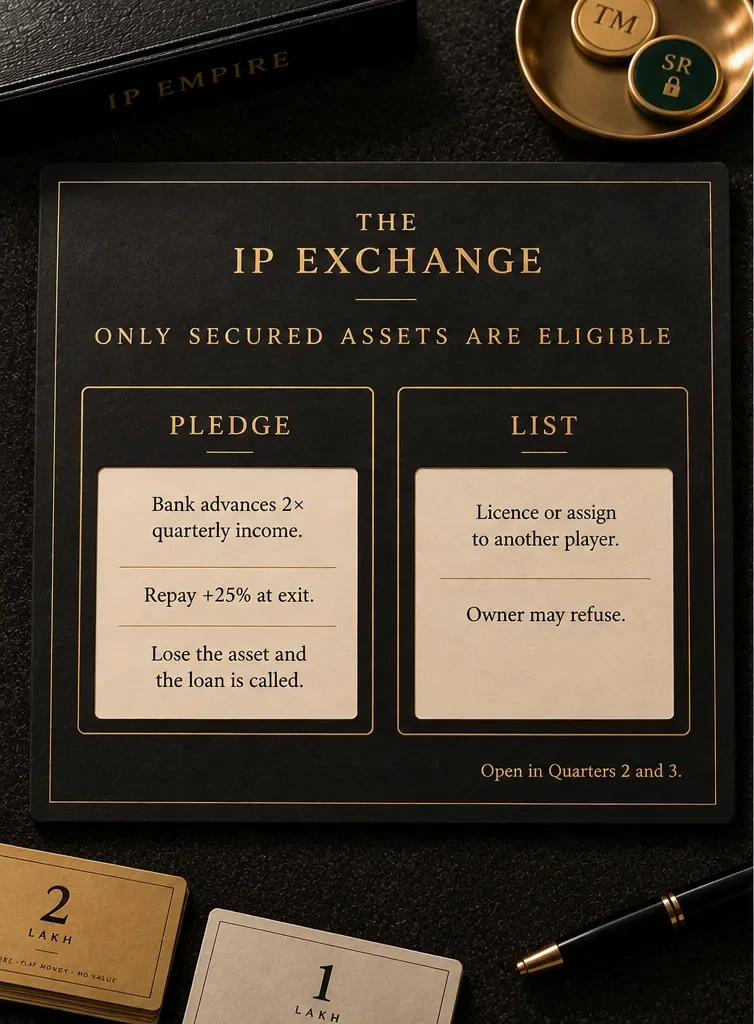
The IP Exchange board with its shutter
The IP Exchange — IP as collateral and as stock

Two windows, Pledge and List. The shutter stays down in Quarter 1 because nothing is secured yet — the board physically refuses to trade an unprotected asset, which saves a paragraph of explanation.

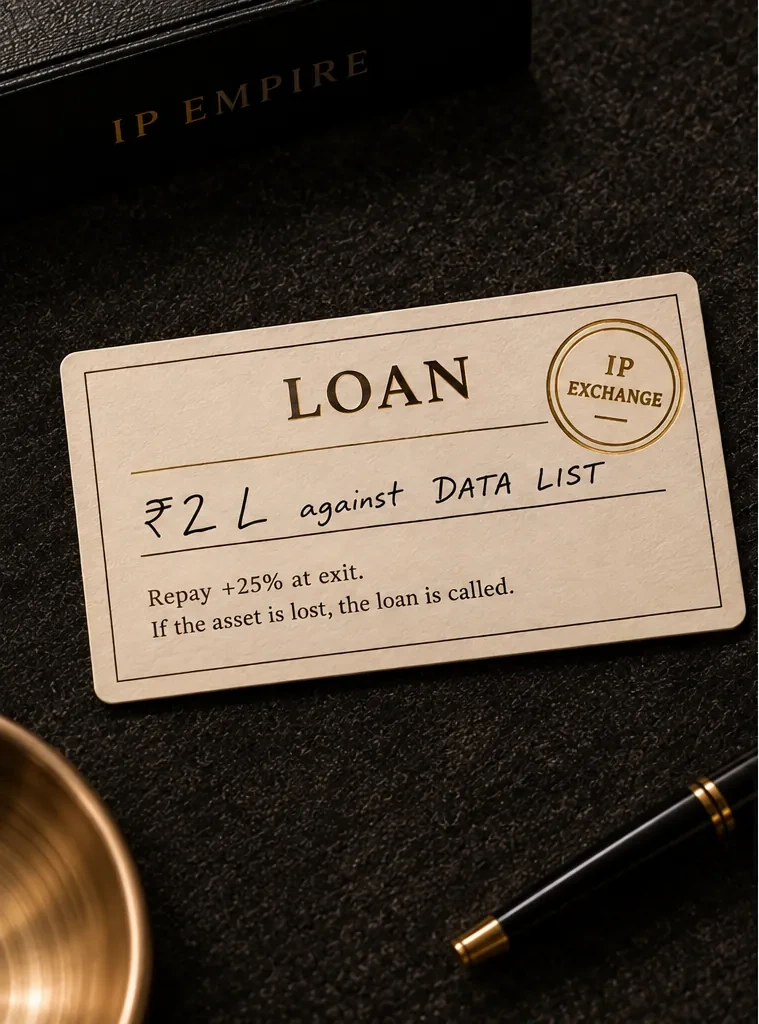
The cream loan chit
The loan chit — IP-backed lending, and its teeth

The bank advances cash against a secured asset. Lose the asset and the loan is called. Borrowing at 2× to make an asset worth 3× is the best trade in the game, right up until someone copies the thing you pledged.

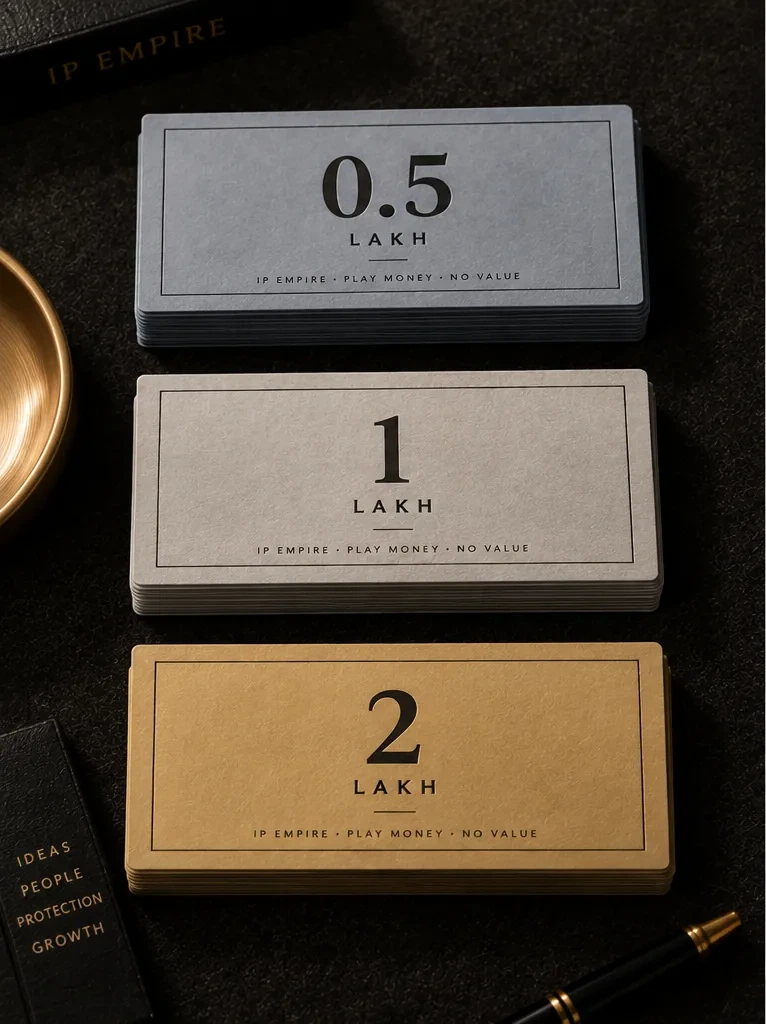
IP Empire cash notes in three denominations
Cash, in three denominations only — allocation, not accounting

₹0.5 L, ₹1 L, ₹2 L. Deliberately coarse, so that no quarter is ever lost to arithmetic. The decision is where the money goes, never how it adds up.

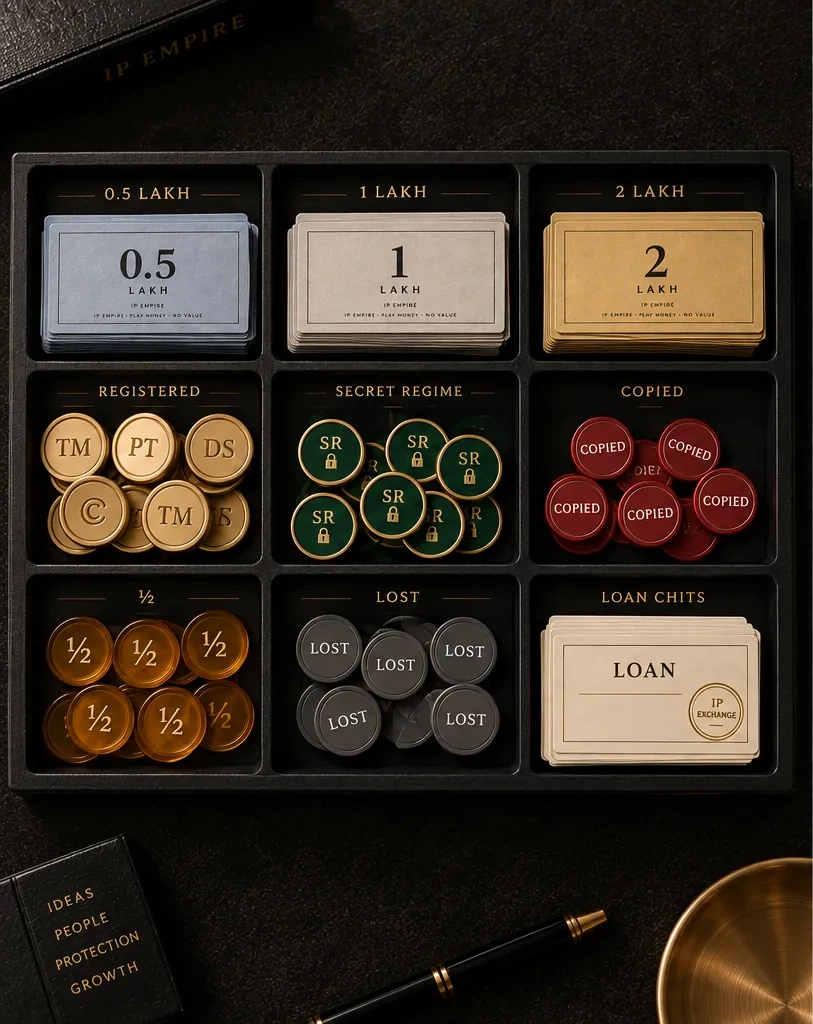
The bank tray holding notes, tokens, chips and loan chits
The bank tray — the cost of protection, in one place

Every token has a price and the tray is where you feel it. Players learn the relative cost of a trademark, a patent and a secret regime by paying for them eleven times in forty minutes.

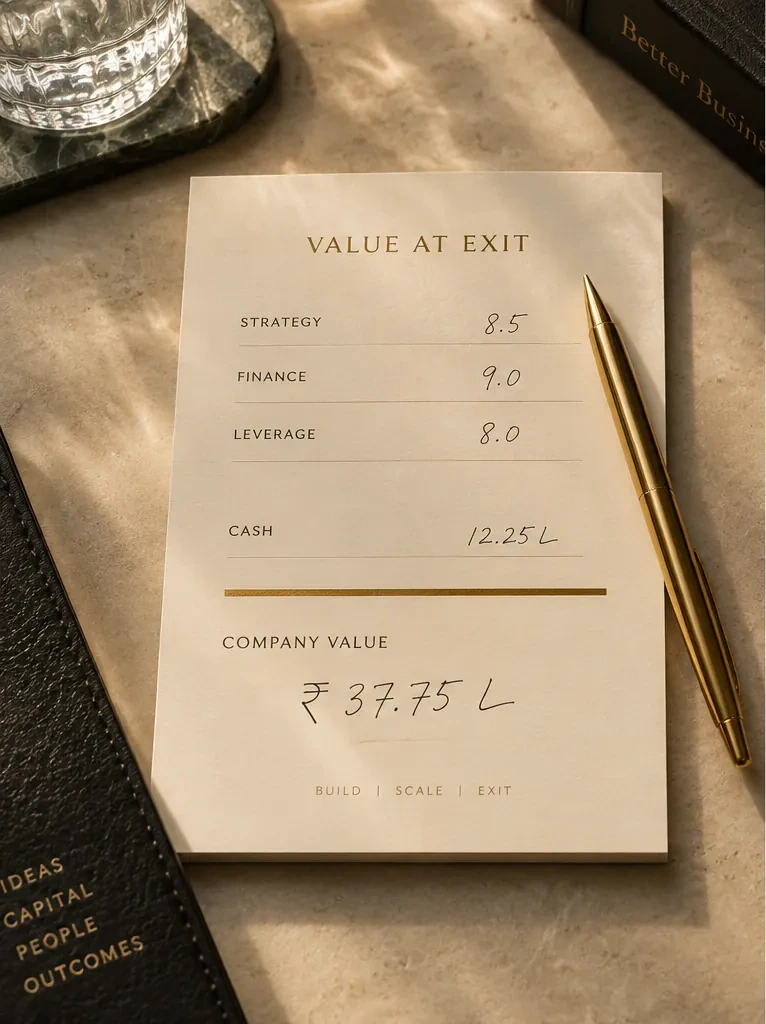
The IP Empire scoresheet
The scoresheet — one number, three reasons

Filled by the player, never the Host. Three lines: what Strategy defended, what Finance raised, what Leverage turned into a multiple. The debrief reads off those three lines rather than off opinions.

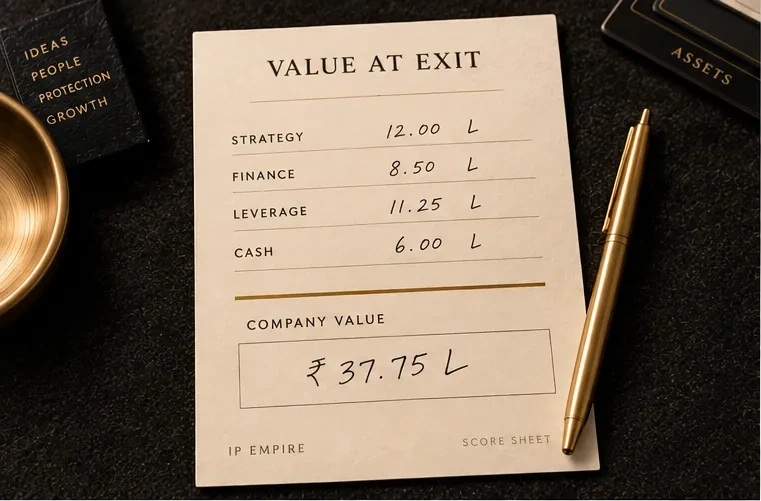
A completed IP Empire scoresheet at the end of a game
Filled in, box closed — the part people photograph

Company value = assets, plus cash, minus loans at 1.25×. Written in the player’s own hand, which is why they argue with it on the drive home rather than forgetting it in the lift.

A quarter is six steps.

Three of them take ninety seconds or less. The clock is visible, and the Host runs it.

/01
Allocate

Each player secretly decides what to protect this quarter and places tokens face-down. Nobody deliberates aloud, and nobody gets to wait and see.

90 s
/02
Reveal

Tokens turned face up, cash paid to the bank. Everyone now sees every mat — including what you chose not to cover.

30 s
/03
Act

One action card each, in seat order. Poach, copy, tear down, litigate or settle. The first seat gets first choice; the last seat has watched four moves.

30 s each
/04
Event

The Host turns one event card and reads it aloud. The same card hits every seat, and each player resolves it on their own mat.

2–3 min
/05
Collect

The bank pays each player the income from the assets they still hold, halved wherever a chip says so.

1 min
/06
Exchange

Quarters 2 and 3 only. Pledge a secured asset for a loan, list one for licence or sale, or pass. The shutter is closed in Quarter 1 because nothing is secured yet.

2 min
The exit

Then the buyer arrives.

After the third Exchange, the Host says four words — “The acquirer is here” — and every seat fills in its own scoresheet. The arithmetic is deliberately blunt, because the lesson is in the multiple and not in the method.

×3

Secured

An asset carrying a token counts three times its income. Registered, documented, enforceable — the only kind the buyer’s diligence will price.

×1

Exposed

An asset you held but never protected counts once. You kept it. You just never made it worth anything to anyone but yourself.

×0

Lost

Poached, called in by the bank, or copied out of existence. Face down on the mat and worth nothing at the table.

−1.25×

Borrowed

Every loan comes off at 1.25× the advance. Leverage against a defensible asset lifts you; leverage against an exposed one is how you lose the asset and the money.

Highest company value wins. In two thousand simulated games, the player who protected nothing and banked the cash did not win once — cash counts one time, and a secured asset counts three. That single line is the whole argument the game exists to make, and nobody has to be persuaded of it, because they watched it happen to themselves.

What the table is forced to decide

Six moments, whichever way you play.

There are about six viable strategies and none of them is the answer. All six meet the same six decisions — and those are the decisions a real portfolio meets, on a slower clock and with more money.

/01

Patent, or keep it secret

₹3 L buys immunity from poaching, copying and reverse-engineering, and qualifies you for the global licence. ₹1 L keeps it in the building and nothing more. Which is right depends on your cash and on who is sitting across the table.

/02

Protect, or hold a reserve

The third token, or a fighting fund. With ₹1 L in hand you can sue, poach, or take an event’s expensive branch. With nothing in hand you watch.

/03

Sue, or settle

Suing is worth about ₹33,000 more on average — but only if you can afford to lose the fee. Enforcement is a budgeted decision with odds attached, not a reflex.

/04

Pledge, or stay unlevered

Borrowing at 2× against an asset that will count 3× is the best trade available. It is also the fastest way to lose both, if the asset you pledged is the one left open.

/05

Register now at double cost, or lose the order

One event puts the price of having waited on the table in rupees. Everybody knows delay is expensive; very few have paid for it in front of four other people.

/06

Protect the dying asset, or let it go

One card is never worth protecting, and almost every player protects it once. Learning to stop spending on an asset with no future is the least comfortable lesson in the box.

What it deliberately does not teach

Run it at your table, or at ours.

IP Empire™ opens a workshop or stands on its own as a board-level session. Five seats, one Host, forty-five minutes and a twenty-minute debrief read off the scoresheets. It is the same material as Harnessing IP for Business Growth, arrived at from the other direction — you make the mistakes first and read the framework afterwards.

Run IP Empire for my team See the full workshop WhatsApp us
The rulebook

Twenty-eight pages, in your hands.

Nothing here is held back. This is the complete A5 rulebook that ships in the box — the goal, the pieces, setup, the quarter, all twenty-five rulings, the thinking layer, the glossary and the one-page quick reference that sits in front of every player. Drag a corner, or use the arrows.

1 / 28

Arrow keys work too. The page-turn is synthesized in the browser rather than a recorded sample — click once to let it start.